
Plants
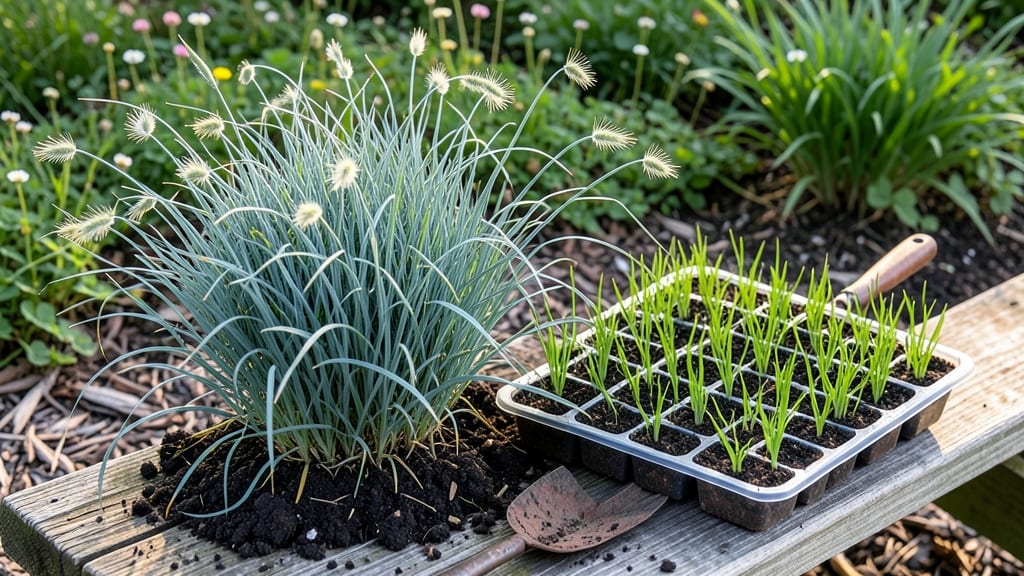
Those vibrant sprouts typically appear within 7-14 days of planting, depending on soil warmth and moisture. 🌱 The key to telling them apart from weeds is their uniform color and dense growth pattern—while weeds often have irregular shapes or yellowish hues.
I've found that maintaining consistent moisture (but not soggy soil) during this stage helps them establish strong roots before weeds get a foothold.
What's interesting is how these seedlings develop: their blades stay narrow (1/16 inch wide) until they're about 2-3 inches tall, when they start forming the classic bluegrass boat-shaped leaf tips.
This early growth phase is when proper care—like avoiding foot traffic—makes the biggest difference in their long-term health.
💡 In This Article
- Identifying Kentucky Bluegrass Seedlings vs. Common Weeds
- Optimal Conditions for Kentucky Bluegrass Germination and Early Growth
Identifying Kentucky bluegrass seedlings vs. common weeds
Kentucky bluegrass seedlings have a distinctive blue-green hue that sets them apart from most weeds. Under close inspection, their blades appear almost translucent with a slight glossiness, measuring just 1/16 to 1/8 inch wide at the base.
This uniformity is key—while weeds like crabgrass develop broader, 3/16-inch-wide leaves, bluegrass maintains its narrow profile until reaching 2-3 inches in height. 🌿 The growth pattern is another telltale sign: bluegrass sprouts form dense, even clusters where each seed produces multiple blades radiating from a single point.
Weeds often reveal their true colors early. Crabgrass, for example, emerges with hairlike projections along its edges and a more yellowish-green tint, while chickweed develops oval-shaped leaves with jagged edges that look nothing like bluegrass's smooth blades.
Even clover, with its characteristic three-leaf clusters, stands out because each leaflet has a distinct rounded shape with a pale vein running through the center. Bluegrass's boat-shaped leaf tips (visible by 2-3 weeks after sprouting) further confirm its identity, as weeds rarely develop such precise geometric forms.
The timing of emergence also helps with identification. Kentucky bluegrass typically breaks through soil within 7-14 days at ideal temperatures (60-70°F), while many weeds like purslane or spurge appear 10-21 days later.
This head start gives bluegrass a competitive advantage if you maintain proper moisture levels—keeping soil consistently damp (but not waterlogged) during this critical window prevents weed seeds from germinating. 💦 The root system develops quickly too: bluegrass seedlings form a fibrous network within 3-4 weeks, while many weeds develop shallow, weak roots that struggle in dense turf.
Lighting conditions can dramatically alter how these seedlings appear. In shaded areas, bluegrass may develop a slightly darker green color, while weeds like dollarweed turn almost black. Conversely, in full sun, bluegrass maintains its vibrant hue, whereas weeds like nutsedge produce yellowish-green shoots with a distinctive triangular stem.
Pay attention to these color variations—healthy bluegrass should never appear dull or patchy during its early growth phase.
Here's a quick visual checklist for field identification:
- Leaf width: Bluegrass 1/16-1/8 inch vs. weeds 1/8-1/4 inch or broader
- Leaf edges: Bluegrass smooth vs. weeds with hairlike projections or jagged edges
- Growth pattern: Bluegrass forms dense clusters vs. weeds with spread-out or random growth
- Leaf tips: Bluegrass develops boat-shaped tips by 3 weeks
- Color consistency: Bluegrass maintains uniform blue-green vs. weeds with yellowish or patchy hues
The most reliable way to confirm identification is to gently pull a seedling and observe its root structure. Bluegrass develops a fibrous root system almost immediately, while many weeds produce a single, thin taproot.
This root difference explains why bluegrass establishes so quickly—its network spreads horizontally, creating a dense turf that naturally crowds out weeds. 🌱