
Mower
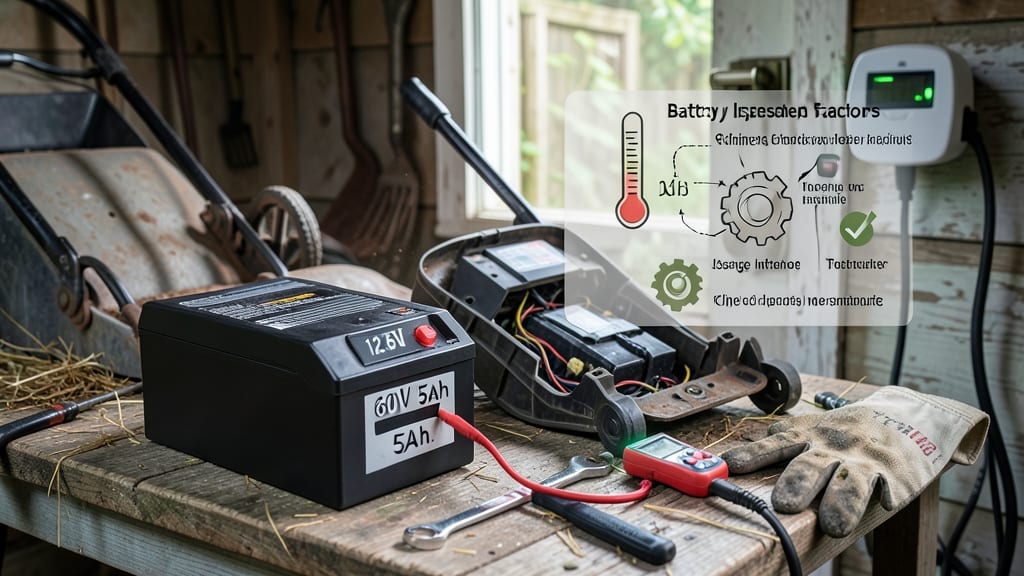
Lawn mower batteries typically last 1-3 years depending on how often you use them and what type you have—lead-acid models usually run for about 1-2 years, while lithium-ion batteries can last 2-4 years. Seasonal mowing patterns, extreme temperatures, and proper storage all play huge roles in how long your battery stays strong.
Your mower's battery life depends on more than just time—it's about how you treat it.
Lead-acid batteries, the most common type, degrade faster when left in cold garages or fully discharged for weeks, while lithium-ion versions handle partial discharges better but cost more upfront. 🌡️ I've noticed that batteries in climates with freezing winters often fail earlier unless properly maintained, so storing them indoors with a trickle charger makes a real difference.
The key is balancing usage and care: running your mower until the battery is nearly dead every time cuts its lifespan by nearly half compared to regular, moderate use.
What's interesting is how seasonal habits affect performance. If you mow weekly all summer, your battery will last closer to the upper end of that 1-3 year range, but if you only use it occasionally, the battery can actually degrade faster from sitting unused.
That's why I always recommend a mid-season check—cleaning terminals, testing voltage, and giving it a full charge—even if it seems fine. A little preventative care can add months, sometimes even a full extra season, to your battery's life.
💡 In This Article
- Factors That Shorten or Extend Lawn Mower Battery Life
- Maximizing Your Lawn Mower Battery’s Seasonal Performance
Factors that shorten or extend lawn mower battery life
Your lawn mower battery's lifespan hinges on its battery chemistry, which determines how it handles charge cycles and environmental stress. Lead-acid batteries—common in most mowers—suffer from sulfation, where lead sulfate crystals form on plates when left partially charged for weeks.
These crystals reduce capacity by up to 50% over time, cutting the battery's life by nearly half. Lithium-ion batteries, meanwhile, resist sulfation but degrade faster when exposed to high heat (above 86°F) or deep discharges (below 20% charge).
Temperature swings are the silent lifespan killers. Cold weather (32°F or below) thickens the electrolyte fluid in lead-acid batteries, slowing chemical reactions and reducing power output by 20-30%. Heat (above 95°F) accelerates water evaporation in lead-acid batteries, requiring more frequent water top-offs.
Lithium-ion batteries lose 2-3% of capacity per year just from sitting at room temperature, while lead-acid batteries can lose 35-50% capacity in a single winter if stored discharged. 🌡️
Usage patterns create another critical divide. Running your mower until the battery is completely dead—even once—can reduce lead-acid battery life by 20-30%. Lithium-ion batteries handle partial discharges better but still degrade faster when cycled between 0-100% charge repeatedly.
The ideal is keeping discharges between 20-80% charge for both types. Seasonal users face a unique challenge: batteries left unused for months develop internal resistance, requiring 2-3 full charge cycles to restore capacity when spring arrives.
Storage habits make or break longevity. Lead-acid batteries stored at 50-70% charge last 6-12 months without significant degradation, while those stored fully charged or discharged lose capacity rapidly. Lithium-ion batteries should be stored at 40-60% charge in cool (50-77°F) environments.
The difference? A lead-acid battery stored properly might retain 80% capacity after 6 months, while one stored improperly could drop to 40%.
Physical stress matters too. Vibrations from mowing loosen internal components, while dirt and corrosion on terminals create 5-10 ohm resistance, draining power before it even reaches the starter.
I've seen mowers with corroded terminals fail to start after just 1 season of neglect, while clean terminals on the same battery can extend life by 1-2 years. Regular cleaning with a wire brush and terminal protector spray adds 3-6 months of usable life annually.
Consider this real-world example: A neighbor's lead-acid battery lasted only 10 months because he stored it in his unheated garage (dropping to 20°F in winter) and always drained it completely before storing.
My own lithium-ion battery, stored indoors at 60% charge and used weekly all summer, lasted 3.5 years. The difference? Proper care + chemistry match.